Scientists currently do not know how to treat fungal infections! Could this lead to a zombie apocalypse?! There are zombie ants living in the Rainforest right now which have been taken over my fungi. Will this transport to humans?! Watch our video to discover more!
The curious question “Why are producing fungal vaccines so hard” is what led our investigations into fungi. We researched what traits allow the organism to infect as well as how the infection could be treated. Fungi are REALLY cool! Many people, including myself, before I did this project, put bacteria and fungi into the same general group. Interestingly, these two categories of organisms are very different. In fact, fungi are more similar to humans than they are to bacteria. While fungi and bacteria are both on the smaller side of organisms and are similar on an intelligence level compared to humans, the reproduction process and treatment against them could not be more different. Fungi reproduce like humans, making a different version of the parent every time they reproduce, while bacteria’s offspring is just a copy of the bacteria they came from. This makes fungal infections extremely hard to treat compared to bacterial infections for reasons we explain in our video.
Savannah and I had a really fun time creating this video! The animations and transition came together in a video which we are very proud of. Researching about fungi and finding thought provoking studies was so cool! I enjoyed this project a lot.
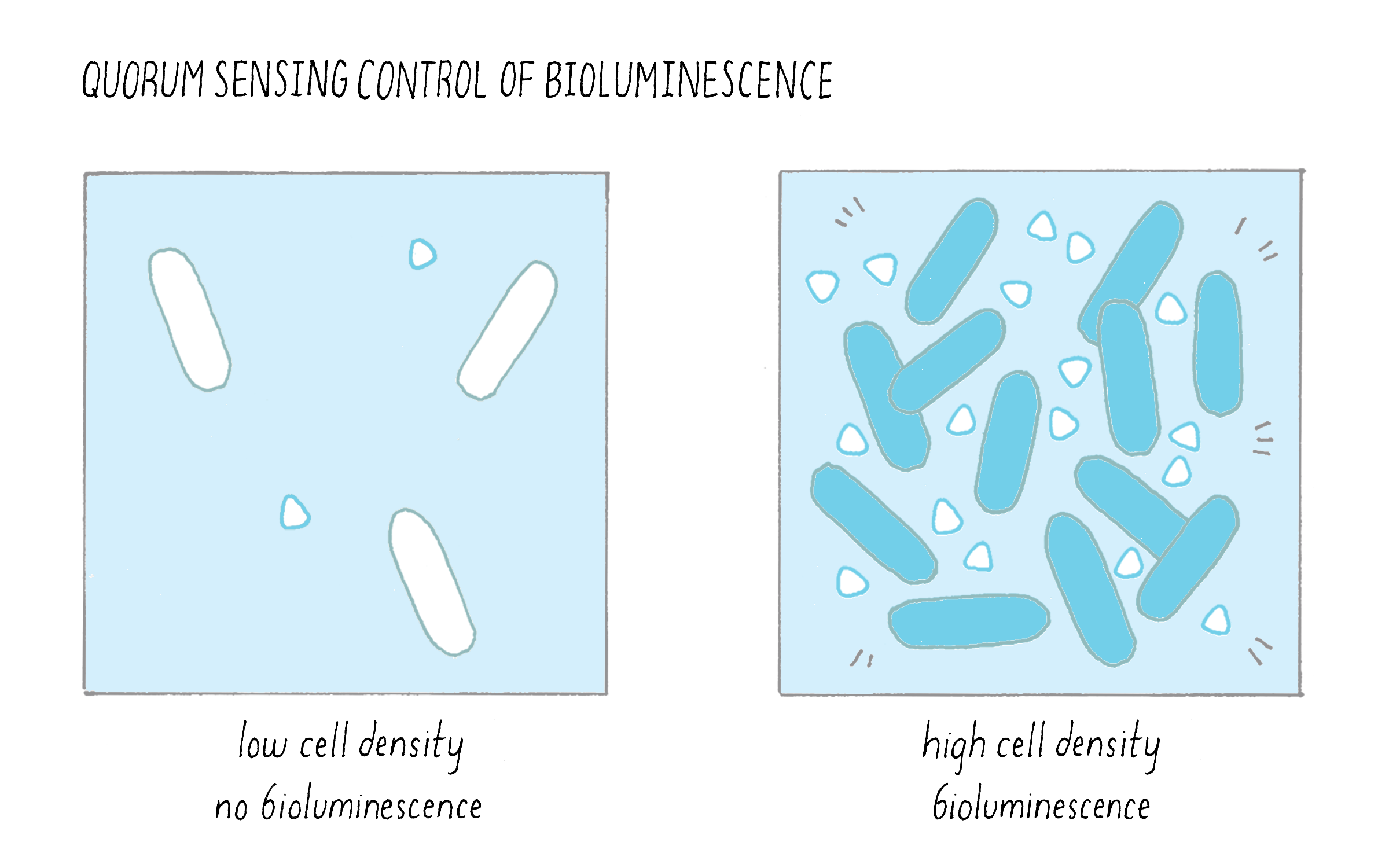
I learned that bacteria are the oldest living organisms on earth, and they only have one piece of DNA. Bacteria can be inherently harmful, causing Lyme disease, toxic shock, food poisoning, and many other conditions. They can also be inherently good, keeping us alive, covering our bodies, keeping environmental factors out, digesting our food, making vitamins, and educating our immune system. Bacteria do not act as individuals. Instead, they work together to function. They do this by talking through a chemical language by secreting molecules that tell the bacteria to function. This was discovered by studying a squid that lives symbiotically with vibrio fisheri, a bacteria that emits bioluminescence. They discovered that this bacteria would only emit light when there was a specific density of bacteria in the area. This was because the bacteria produce auto-inducer molecules that can detect ‘sibling’ bacteria in the area.
(Quorum Sensing | Bacterial Communication | by Bonnie Bassler)
What I found the most interesting was how bacteria communicate to see how efficiently they can harm their host. The bacteria can produce there chemical signals that are unique to their species of bacteria, but there are also Quorum Sensing molecules that can sense for antigens, pathogens, and many other factors. With this knowledge, they know whether or not their density of bacteria will efficiently work. If their concentration is greater than others around, then they will produce their virulent properties. I found it interesting that scientists can interfere with these chemical signals in new types of anti-bacterial medications to tell the bacteria not to harm the host.
I want to share with my audience that you should always keep exploring and being curious. This is very new in the world of science and would have never been discovered if it weren’t for Bonnie Bassler‘s curiosity. She said to our class to never be discouraged when doing something hard, and I hope that that is a message readers take with them.
Her talk made me curious about what innovations will come and how this new technology will develop. It also makes me wonder if, after all this research and energy, the new anti-bacterial medications will work.
Works Cited:
“Bacteria and the Power of Teamwork | Bonnie L. Bassler.” Princeton University, The Trustees of Princeton University, basslerlab.scholar.princeton.edu/news/bacteria-and-power-teamwork. Accessed 26 Nov. 2023.
BL;, Miller MB; Bassler. “Quorum Sensing in Bacteria.” Annual Review of Microbiology, U.S. National Library of Medicine, pubmed.ncbi.nlm.nih.gov/11544353/#:~:text=Quorum%20sensing%20is%20the%20regulation,a%20function%20of%20cell%20density. Accessed 26 Nov. 2023.
“Bonnie L. Bassler | Department of Molecular Biology.” Princeton University, The Trustees of Princeton University, molbio.princeton.edu/people/bonnie-l-bassler. Accessed 26 Nov. 2023.
Dr. Bonnie Bassler has been a part of research to understand bacterial behavior for 30 years. Over her time as a researcher, she has made many groundbreaking discoveries that have led to advancements in bacterial breakthroughs.
To begin, it is crucial to understand that bacteria are the Earth’s most ancient organisms. Previously, people believed that bacteria were very primitive and they have only been known about for 500 years. Until recently, scientists have believed that bacteria are asocial, as a result of their primitiveness. This is entirely untrue. People are constantly collaborating with their microbiomes and microorganisms, they give us vitamins, help digest vegetables, help the immune response, and more. This is due to the communication between individual bacteria.
This breakthrough in bacteria was discovered by looking at squid symbiosis. The vibrio fischeri bacteria provides bioluminescence for the Bobtail Hawaiian Squid when it goes out to hunt at night. The squid has sensors on its back to measure the amount of moonlight refracting through the ocean. The bacteria then adjust its concentration accordingly, and the squid can camouflage itself from predators and prey. For more information on the squid, watch below!
The reason this works is because of bacterial quorum sensing. Each bacteria releases autoinducer molecules that sense the presence of other bacteria. When the molecules sense a certain concentration of other bacteria, that will cause the bacteria to light up or to act according to their species. Bacteria also have sensors for other species of bacteria and even eukaryotic cells.
The part that I found the most interesting was that by using these discoveries, scientists can use them to stop the pathogenicity of clinically relevant bacteria. People are in the process of creating molecules that interrupt bacterial quorum sensing. Some are inhibitors that block the response of bacteria to these molecules, rendering them “deaf,” or overstimulating the bacteria with false molecules that will cause the bacteria to act too soon and reveal themselves to the immune system. These are incredible breakthroughs that are eliminating the need to depend on antibiotics.
I learned many things when watching Bonnie Bassler’s presentation. I thought it was very generous of her to come on and spend time talking in real time with us and even answering some of our questions. Before learning from Bonnie I thought what she said most people believe about bacteria is that they live a boring life/ are asocial and just harm humans. Now I know, they do so many beneficial things for us, like, they act as an invisible body armor, digest food, make vitamins, and even educate the immune system. I also learned they talk with chemical language (think like human hormones) to do things like come together/ obtain a high enough cell density and turn on their light simultaneously; bioluminescence. This is scientifically called quorum sensing and the process starts with all bacteria talking to each other by making chemical words, they then recognize those words, and turn on group behaviors that only work in unison. This is also used in virulence as bacteria will get in you and wait, then they start growing, count themselves, and recognize when they have the right cell number, they can launch an attack and be successful. Something I thought was so interesting was that humans have 10 times more bacteria cells than human cells and 100 times more bacteria genes than human genes at all times. I also love the visuals Bonnie showed as she talked as it helped me visualize what is actually happening in our body as she spoke! If I get the chance to speak to Bonnie again, some questions I have for Bonnie are “why can’t we feel the bacteria on us?” and “how do we distinguish good vs. bad bacteria?” Both of these questions came up for me because she mentioned we cannot see bacteria with a naked eye but not why can’t we feel them and she mentioned how bacteria can be good and can be bad but I would have loved for her to tell us how we know the good from the bad? What are the characteristics that stand out?
If you guys want to check out Bonnie talking about this interesting subject in more depth, check out her amazing TedTalk here: