“For the things we have to learn before we can do them, we learn by doing them.”
--- Aristotle
Aristotle's quote from The Nicomachean Ethics highlights the importance of practice during learning, which was why in AP Bio, our class participated in a fetal pig dissection practical. Observing and studying the internal structures of the fetal pigs would not only foster our understanding of body systems but also prepare us for more dissections in college biology classes.
Intrdocution
Back in middle school, I did a dissection of a cow's heat. However, I was too nervous at the time to dissect or make observations about the real cow's heart. Therefore when I felt ready for the dissection, I volunteered to dissect the fetal pig to make up for what I missed out on previously, and gain more experience in dissecting since I am interested in majoring in a biology-related field in college.

Exploration
Our class members were assigned into teams with three switchable roles, dissecting, note-taking, and setting up Z Space. Due to my interest in taking an active role in the dissection, I was honored to be chosen as the lead operator to dissect the pig with my teammates. When our team collected the assigned fetal pig, we found that the pig was different from our expectations --- dry, yellowish, and smelled of chemicals used to preserve the body. We also learned that because the fetal pig's veins and arteries were hard to discern from one another, the veins were dyed blue while the arteries were dyed red.
Things always start hard and become easier. The first incision was intended to be made somewhere on the umbilical cord to show the cross-section of the pig's umbilical cord. Due to our inexperience and some squeamishness, we were unsure whether the cut should be made sideways or sever the cord. With the help from our teacher, Mrs. Girard, and support from one another, we soon became more able to follow the steps of dissection with more confidence and efficiency.
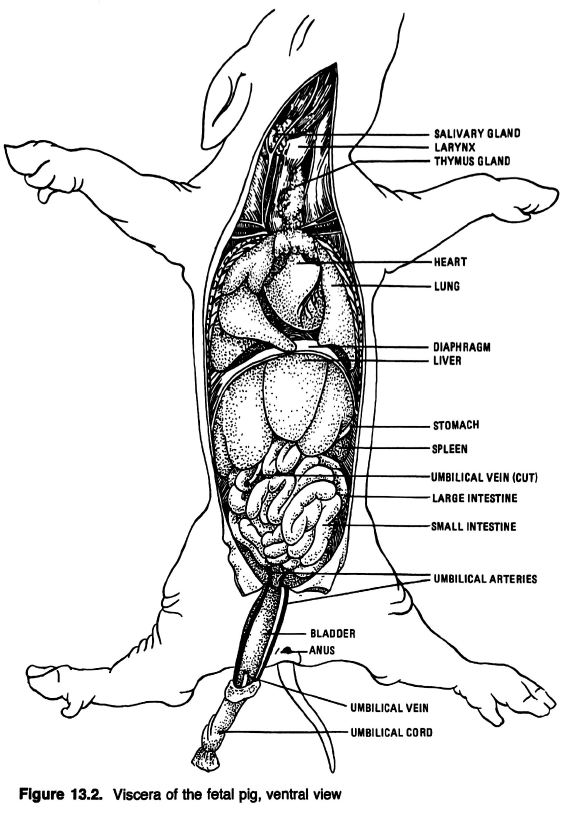
The first body system we explored was the digestive system, which involved long cuts across the abdomen to open the cavity. The digestive system was the easiest body system to identify because it took up the majority of the space in the pig. With encouragement from my teammates, I cut off some skins from the pig's abdomen and we saw something surprising --- our fetal pig's abdomen was filled with blue dye, an error caused by an excessive amount of dye injected into the pig. Our teacher had to cleanse the pig for us to observe the pig properly. When the pig was brought back to us, we removed the organs from the pig to make closer examinations. Our team discerned four lobes from the liver, identified the pancreas as part of the digestive system, and discussed that the liver's function was to filter blood. There were also questions left unanswered and required information from outside sources. After doing some research, I learned that the gall bladder was responsible for storing bile secreted by the liver and the spleen was responsible for specialized immune cells, lymphocytes, to identify and fight pathogens.
By the time our team finished exploring the digestive system, I switched my role with other teammates and started taking notes. The respiratory and circulatory systems were the next body systems we explored, which required long incisions all the way up to the jaw from the abdomen. As soon as the pig's chest was opened, we saw pericardium surrounding the heart, which was a layer of thin film that would keep the heart in the chest cavity during movement. We discussed that the rings of cartilage surrounding the trachea were responsible for the movement of air since the trachea is crucial to draw air into the respiratory system. I also did more research which showed that in the circulatory system, the ventricle wall is thicker than the arterial wall because more muscles can be used to apply more pressure to fulfill the ventricle's crucial role in pumping blood out of the heart into arteries throughout the body.

The last body system, the reproductive system was the most challenging one to identify. We were running out of time and the reproductive system took a small portion of the pig's body. While exploring the pig's reproductive system, our team soon corrected a mistake we made --- we had assumed that we were assigned a female fetal pig. Our dissection revealed a pair of testis instead of ovaries in the pig's reproductive system. Our pig was also more mature compared with other teams', which meant that our pig had larger testis easier to observe compared to other ones.
Reflection
I am grateful to participate in the fetal pig dissection before the end of the year. The practical helped me to better understand the body system and familiarize myself with the process of dissection. I also enjoyed working with teammates to figure out how to proceed in the process and learn together.
Works Cited
Fetal Pig Dissection Labs - Dr. J. Lim, https://www.shsu.edu/academics/agricultural-sciences-and-engineering-technology/documents/FetalPigDissectionLab_000.pdf. Accessed 23 May 2023.
“Circulatory system - Walla Walla.” Whitman College, https://www.whitman.edu/academics/majors-and-minors/biology/virtual-pig/circulatory-system. Accessed 23 May 2023.
“Digestive system - Walla Walla.” Whitman College, https://www.whitman.edu/academics/majors-and-minors/biology/virtual-pig/digestive-system. Accessed 23 May 2023.
“Histology & Anatomy of Fetal Pig - Lungs.” College of the Canyons, https://www.canyons.edu/academics/biology/resources/lab107/thoracic/lung.php. Accessed 23 May 2023.
“Umbilical cord.” Wikipedia, https://en.wikipedia.org/wiki/Umbilical_cord. Accessed 23 May 2023.

No comments:
Post a Comment