Wednesday, September 6, 2023

FLOW - For Love Of Water

 FLOW – For Love of Water is an organization that focuses on making clean drinking water available to everyone in the world. FLOW emphasizes the idea that water is a human right and that everyone should be able to have access to it. 

FLOW created a documentary in 2008, sharing the idea that large water companies, such as Nestle and Coca-Cola, are withdrawing large amounts of water from communities and are making profit from it. These companies withdraw this natural water to create bottled water, while instead water should just be a natural resource. These companies sell these bottled waters for large amounts of money, as a way for the company to make profit. 


As I was watching this documentary, many things within this film surprised me. I was shocked by the idea that most bottled water companies do not truly get their water from freshwater sources. Most companies, such as Nestle, get their bottled water from the tap. This idea shocked me because it made me realize that people are spending tons of money to receive tap water. I was also surprised by the idea that dams are very harmful to communities. I never knew that dams affected people greatly. When dams displace people, their lives are forever changed. In the 20th century, 40 to 80 million people were displaced due to dams. The creation of dams can also create an increase of methane gas, leading to the Greenhouse Effect. 


After watching the entirety of the documentary, I learned that the filmmaker is trying to persuade the audience to stand up against the issue of large water companies withdrawing water from communities. The only way that these water companies can be stopped is through local efforts. We have to come together as a society and save our water. The filmmaker also wanted to inform the audience of the many water supply issues, such as water companies selling tap water. 


Since FLOW has been released, there have been many heated debates surrounding bottled water companies, such as Nestle and Coca-Cola. Within the documentary, many arguments were made in opposition of Nestle bottling water in Michigan. Despite these oppositions, a permit was passed, approving Nestle to increase the amount of water they withdrew from the state’s groundwater table from 250 gallons a minute to 400 gallons. Many people spoke up to oppose this permit. 81,862 people from Michigan filed complaints about the Nestle permit, and only 75 of those people were in favor of the permit. Although Nestle received a permit allowing them to increase the amount of water they withdrew, they never followed through. In 2021, Nestle surrendered the permit, and they never increased their withdrawal from Michigan. The water withdrawal increase would have fed a $36 million expansion of Nestle Ice Mountain bottled water. Coca-Cola also continued to withdraw groundwater from small communities after the documentary was created. In 2014, the water quality was said to have worsened tremendously. Another problem has arisen due to these water companies withdrawing. Most of these companies claim that they are being “bottled from the source.” This indicates that they are pulling this water straight from the ground, and are destroying the environments around it. 


Nestle’s effect of withdrawing water from Michigan. 


Click photo to access FLOW documentary.


Works Cited


“Clean Water for All – FLOW.” FLOW for Waterhttps://forloveofwater.org/clean-water-for-all/. Accessed 06 September 2023.


Dvc-Admin. “Which Bottled Water Brands Contain Tap Water?: Blog.” The Water Depot, 7 July 2023, https://thewaterdepot.com/bottled-water-brands-that-contain-tap-water/#:~:text=But%20did%20you%20know%20that,get%20from%20your%20kitchen%20faucet. Accessed 06 September 2023.


“FLOW For Love of Water – Watch Free Online.” Documentary Maniahttps://www.documentarymania.com/video/FLOW+For+Love+of+Water/. Accessed 06 September 2023.


Gray, Kathleen. “Michigan Oks NestlĂ© Permit for Increased Water Withdrawal for Bottled Water Plant.” Detroit Free Press, Detroit Free Press, 2 Apr. 2018, https://www.freep.com/story/news/2018/04/02/michigan-oks-nestle-permit-increased-water-withdrawal-bottled-water-plant/479896002/. Accessed 06 Sept. 2023.


“How Dams Affect People and the Environment.” How Dams Affect People and the Environmenthttps://britishdams.org/about-dams/dam-information/people-and-environment/. Accessed 06 Sept. 2023.


Tuesday, May 16, 2023

Exploring the Fetal Pig Dissection

Exploring the Fetal Pig Dissection

After all of our hard work as Team AP Bio, we were rewarded with the opportunity to explore mammalian body systems on our own with our fetal pig dissection!

This image has an empty alt attribute; its file name is screen-shot-2023-05-23-at-3.22.09-pm.png

The first day of the dissection, I was VERY intimidated by the fact that the pig was real. As someone who works in veterinary medicine, I had so much sympathy for the animal and did not want to make any incisions to its body. However, as you can see in these pictures, by the second day I was fascinated by the pig's bodily functions.

One thing that made me curious was when one of my teammates asked my teacher about the pigs' brains. Initially I had no intention of actually dissecting the brain, until my teacher mentioned that a few of her previous students had done it successfully. Hearing this, I went back to my table and cut an opening in the head, careful not to pierce through to the brain. I had originally just cut out of curiosity of seeing the brain, but then decided to remove it, which I did shortly after.

This image has an empty alt attribute; its file name is screen-shot-2023-05-23-at-3.21.34-pm.png

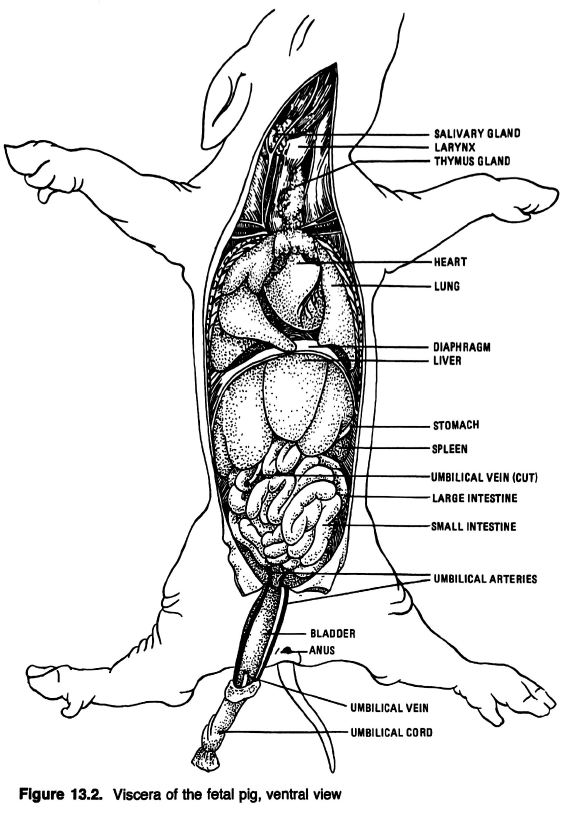
After the pig dissection, I have learned how to locate many parts of the body and name their functions. For example, I had always known what the job of the liver is, but I had no idea how large it would be in comparison to the rest of the body. I also learned that the diaphragm is a thin muscle that acts as a barrier between the respiratory cavity and digestive cavity.

Dissecting the fetal pig helped me learn more about our bodies as humans, and why we need to take precautions such as wearing helmets and seatbelts. I also learned more about where each internal organ is located, which will be good background knowledge for college, where I will be majoring in biology on the pre-med track. Overall, I am grateful for the experience we had and will always remember the dissection!


Monday, May 15, 2023

Fetal Pig Dissection

warning: this post contains diagrams of dissected fetal pigs that could cause nausea  
“For the things we have to learn before we can do them, we learn by doing them.” 
--- Aristotle


Aristotle's quote from The Nicomachean Ethics highlights the importance of practice during learning, which was why in AP Bio, our class participated in a fetal pig dissection practical. Observing and studying the internal structures of the fetal pigs would not only foster our understanding of body systems but also prepare us for more dissections in college biology classes. 

Intrdocution

Back in middle school, I did a dissection of a cow's heat. However, I was too nervous at the time to dissect or make observations about the real cow's heart. Therefore when I felt ready for the dissection, I volunteered to dissect the fetal pig to make up for what I missed out on previously, and gain more experience in dissecting since I am interested in majoring in a biology-related field in college.

Check out this @Behance project: "Fetal Pig Dissection Manual"  https://www.behance.net/gallery/72165099/Fetal-Pig-Dissection-Ma… | Pig  dissection, Dissection, Fetal

Exploration

Our class members were assigned into teams with three switchable roles, dissecting, note-taking, and setting up Z Space. Due to my interest in taking an active role in the dissection, I was honored to be chosen as the lead operator to dissect the pig with my teammates. When our team collected the assigned fetal pig, we found that the pig was different from our expectations --- dry, yellowish, and smelled of chemicals used to preserve the body. We also learned that because the fetal pig's veins and arteries were hard to discern from one another, the veins were dyed blue while the arteries were dyed red.

Fetal Pig Dissection Manual (BIOL 105)

Things always start hard and become easier. The first incision was intended to be made somewhere on the umbilical cord to show the cross-section of the pig's umbilical cord. Due to our inexperience and some squeamishness, we were unsure whether the cut should be made sideways or sever the cord. With the help from our teacher, Mrs. Girard, and support from one another, we soon became more able to follow the steps of dissection with more confidence and efficiency.

Anatomical Drawings of a Fetal Pig

The first body system we explored was the digestive system, which involved long cuts across the abdomen to open the cavity. The digestive system was the easiest body system to identify because it took up the majority of the space in the pig. With encouragement from my teammates, I cut off some skins from the pig's abdomen and we saw something surprising --- our fetal pig's abdomen was filled with blue dye, an error caused by an excessive amount of dye injected into the pig. Our teacher had to cleanse the pig for us to observe the pig properly. When the pig was brought back to us, we removed the organs from the pig to make closer examinations. Our team discerned four lobes from the liver, identified the pancreas as part of the digestive system, and discussed that the liver's function was to filter blood. There were also questions left unanswered and required information from outside sources. After doing some research, I learned that the gall bladder was responsible for storing bile secreted by the liver and the spleen was responsible for specialized immune cells, lymphocytes, to identify and fight pathogens.

Fetal Pig Dissection

By the time our team finished exploring the digestive system, I switched my role with other teammates and started taking notes. The respiratory and circulatory systems were the next body systems we explored, which required long incisions all the way up to the jaw from the abdomen. As soon as the pig's chest was opened, we saw pericardium surrounding the heart, which was a layer of thin film that would keep the heart in the chest cavity during movement. We discussed that the rings of cartilage surrounding the trachea were responsible for the movement of air since the trachea is crucial to draw air into the respiratory system. I also did more research which showed that in the circulatory system, the ventricle wall is thicker than the arterial wall because more muscles can be used to apply more pressure to fulfill the ventricle's crucial role in pumping blood out of the heart into arteries throughout the body.

Lab 7: Vertebrate Anatomy - OpenWetWare

The last body system, the reproductive system was the most challenging one to identify. We were running out of time and the reproductive system took a small portion of the pig's body. While exploring the pig's reproductive system, our team soon corrected a mistake we made --- we had assumed that we were assigned a female fetal pig. Our dissection revealed a pair of testis instead of ovaries in the pig's reproductive system. Our pig was also more mature compared with other teams', which meant that our pig had larger testis easier to observe compared to other ones.

Reflection

I am grateful to participate in the fetal pig dissection before the end of the year. The practical helped me to better understand the body system and familiarize myself with the process of dissection. I also enjoyed working with teammates to figure out how to proceed in the process and learn together. 


Works Cited

Fetal Pig Dissection Labs - Dr. J. Lim, https://www.shsu.edu/academics/agricultural-sciences-and-engineering-technology/documents/FetalPigDissectionLab_000.pdf. Accessed 23 May 2023.

“Circulatory system - Walla Walla.” Whitman College, https://www.whitman.edu/academics/majors-and-minors/biology/virtual-pig/circulatory-system. Accessed 23 May 2023.

“Digestive system - Walla Walla.” Whitman College, https://www.whitman.edu/academics/majors-and-minors/biology/virtual-pig/digestive-system. Accessed 23 May 2023.

“Histology & Anatomy of Fetal Pig - Lungs.” College of the Canyons, https://www.canyons.edu/academics/biology/resources/lab107/thoracic/lung.php. Accessed 23 May 2023.

“Umbilical cord.” Wikipedia, https://en.wikipedia.org/wiki/Umbilical_cord. Accessed 23 May 2023.


Thursday, May 11, 2023

Health Symposiums: Tourette’s Syndrome

Previously on Team AP Biowe were put into groups to learn about genetic health symposiums and my group had the topic of Tourette’s Syndrome. There is a certain stigma on Tourette’s Syndrome that the syndrome is just people randomly swearing. However, that is only one result of many possible physical symptoms of Tourette’s. There are many possible genes that could be the cause of Tourette’s, but the most well known gene is SLITRK1 found on chromosome 13. A mutation in the gene SLITRK1 is del1264C where a single base pair is deleted. The deletion is leads to a shorter version of the SLITRK1 protein. Patients with Tourette’s can usually be recognized by their tics. Tics are repetitive, sudden, uncontrolled movements and sounds that occur when the nervous system overreacts and can be categorized into motor tics and vocal tics, both with subcategories of simple and complex tics. Motor tics can appear as twitches, winking, and sudden movements and vocal tics can consist of humming, clicking, and blurting out sudden words and phrases.


I was excited to study and research about Tourette’s Syndrome because a few of the comedians that I admire have Tourette’s and educate and advocate for people with Tourette’s. When researching, it was difficult for my group to research the specific genes that could cause Tourette’s because there is little known about the genes. So, we did that best that we could with the information we could find on an uncommon gene that causes Tourette’s. Coming up with ideas was not that difficult as everyone in our group was very creative. So, when we realized we had limited time to do an idea of an in-person lesson, we decided to do the lesson on Zoom. Another part of our project was to interview a person of close relation to a patient with the health symposium, a person who works with patients, or a patient of the symposium. Although we reached out to a patient and two doctors that worked with and did research on Tourette’s, we did not get a response back for a while; finding someone to interview was very difficult with conflicting school and work schedules. Fortunately, a patient with Tourette’s responded in time to complete the project. Overall, the project was very educational and it was enjoyable to work with my teammates. Although we had a few obstacles, we were able to complete the project satisfied with our work.

Tuesday, April 18, 2023

Church versus Science?

Most people have the impression that the church is less receptive to science. In the story of history, there are many scientists who made new discoveries but were pressured by religion not to express their views openly. So are Catholic ideas at odds with science? If so, is there a way out of this? In an AP biology class, we discussed and studied.

At the beginning of our group's discussion, we thought that Catholic ideas were in direct conflict with scientific ideas. The Catholic Church, for example, believes that God created everything, including different species and the distribution of species to different regions. And scientists think it all has to do with natural selection. Therefore, from the superficial relationship, the Catholic concept and the scientific concept are not mutually tenable, or even in conflict.


However, after our group conducted a series of data searches, it was found that there was no direct conflict between Catholic beliefs and scientific beliefs about the evolution of species. In fact, the Catholic Church has never expressed a direct opposition to evolution. The Catholic theory of evolution does not conflict with the belief that God created everything. Because God didn't influence evolution, he just created it. God is like a watchmaker, not a magician. Many people think that the Catholic concept and the scientific theory of evolution are in absolute opposition, but in fact, they are mutually complementary. In the video we found, it mentions that Catholics believe that God created an orderly universe and that if you want to get closer to God you need to use science. Science can make people feel the greatness of God as the creator.

This is also a very new perspective for me. In my past study, I thought it was very unrealistic to view science through religion or religion through science. Because the two are in conflict, after this understanding, I found that there is no such relationship. Even Catholics agree that evolution is true, not that people are prejudiced against the science of evolution. It also taught me that people need more information when looking at a seemingly extreme problem. Then make certain conclusions about the relationship between the two things, rather than through their own prejudice to the relationship between the two things.

Work Cited

“Catholic Church and Evolution.” Encyclopedia, https://encyclopedia.pub/entry/31938.

“Student Positions on the Relationship between ... “- Wiley Online Libraryhttps://onlinelibrary.wiley.com/doi/10.1002/tea.21302.

 Central, Catholic, director. Creation & Evolution | Catholic Central. YouTube, YouTube, 10 Nov. 2017, https://www.youtube.com/watch?v=B_sE07heyy4&t=129s. Accessed 31 Mar. 2023.

Jose Ramon, et al. "Pope Francis." Wikipedia, https://en.wikipedia.org/wiki/Pope_Francis.  Accessed 31 March 2023.

Tharoor, Ishaan. "Pope Francis says evolution is real and God is no wizard." The Washington Post, 28 October 2014,  https://www.washingtonpost.com/news/worldviews/wp/2014/10/28/pope-francis-backs-theory-of-evolution-says-god-is-no-wizar d/. Accessed 31 March 2023.

Wednesday, April 5, 2023

The Church and Science

 Why is teaching evolution at a Catholic school controversial? How different do you think science and the Church really are? Many Catholics believe that the topic of evolution should not be taught in Catholic schools because they contradict each other. However, is this really the case? Let's dive in a bit deeper.

Before we started this project, we had to discuss as a group, what we thought the Church's views on our topics were. Most groups believed that the Church was against ideas of evolution or the Big Bang theory, however, Pope Francis stated, "The evolution in nature is not opposed to the notion of Creation because evolution presupposes the creation of beings that evolve" (Welsh). The Church believes that God initiated the creation and continued work through evolution. Contrary to popular belief, science is said to bring us closer to God rather than further.

My group solely focused on CRISPR/gene editing and the Church's views. Our group believed that the Church would be against CRISPR because the Bible states everyone is "made through the "image and likeness" of God, so people should not genetically change who they are. The Pope has openly said treatments for genetic diseases are a good thing, however, is 100% against using CRISPR on embryos. Changing embryos is not only very controversial in the science world because editing embryos change that embryos germline forever, but is also controversial in the Church's views as well. Pope Francis believes that testing on embryos takes part in "throwaway culture", which he defines as human life no longer seen as a primary value to be respected or safeguarded.

Overall, I think my group did a pretty good job on our presentation. We managed our time wisely and discussed these topics without any biased opinions. I think one "glow" for our project was that we discussed certain aspects of gene editing rather than gene editing as a whole because the Church was against embryonic testing and not so much testing with genetic diseases. We had little writing on our slides and made our slides engaging for the class. One thing I could have done better is discussing more on the Pope's views on CRISPR because I couldn't really find any information that was new, most of the websites had pretty much the same (if not very similar) information.


I actually found this project very interesting. I believed that the Church was against evolution, the Big Bang Theory, or gene editing. To my surprise, the Church supports both evolution and the Big Bang Theory. The Big Bang Theory talks about the origin of the universe and NOT the creation, which the Church specifies as two different ideas. The Church also supports evolution because for evolution to occur, God would have needed to create creatures that would end up evolving.

Learning more about the Church and Science made me wonder why these ideas are not discussed more often. This project helped me gain insight into the Church's and Pope's actual views on scientific topics. Thank you, hope you learned a little something as I did!

Tuesday, April 4, 2023

Church vs. CRISPR


Church vs. CRISPR

In class on Friday, March 31, I researched the Catholic Church’s view on CRISPR technology being used today. My team and I put our information on a slide deck (linked below).


I enjoyed doing this project because I got to see both sides and point of views on CRISPR technology. One thing that I could have improved with was being more prepared for questions being asked in class. I think we could have had more information as well because our information was very similar to each other and had the same arguments. I think our project was well done with the time we had to do the project, but if given more time, could have been more specific.

Wednesday, February 22, 2023

Ghosts Hide and Appear in Your Genes

 What do you mean ghosts hide in your genes? Can they appear sometimes and be invisible at other times?

Yes! Some genomes that carry functions can appear on sometime(turned on) and fade(turned off) just like a light switch. The function changes are called Epigenome. Within a chain of DNA in a genome, modifications regulate gene expression is known as the epigenome. The epigenetic changes will turn genes on/off to influence the gene expression.  

One second, how is modification made?

In simple words, your genetic material(DNA) makes instructions on how a chain of amino acids is assembled into a protein.  The process of DNA makes transcription & translation. A chemical that attaches to DNA can change DNA’s function. The chemical is called histone( sphere particles as shown below). The genome that Histone attached is “marked”  The genome instruction is changed. As cell division happens. The changed functioned DNA will pass from generation to generation. And the marks turn your genome on/off. 

What is the specific definition of epigenome? Go visit epigenomics 

DNA marked by chemical tags on the DNA can turn on/off throughout your life. Your epigenetics at birth may be different from the epigenetics during childhood and adulthood. What is the factor that determines at what condition the genome turns off?

The answer is that lifestyle and environment can change the epigenomes. Some of which can be damaging, such as smoking, diet, infectious disease.  In one case that I researched: A shift from clean environment to a environment with heavy metals and microplastic can affect the genome through a gene expression change. Nucleus exposed to a heavy metal environment can lead to DNA methylation changes in thousands of genes discovered by  Daniel Shaughnessy, Ph.D. Learn more about what other environmental conditions change the epigenomes? Go explore this link .

Hope you have a basic understanding about the “Ghost” in your gene. Let me know more in the comment!

Tuesday, February 21, 2023

Ghost in Your Genes

The documentary Ghost in Your Genes by Nova productions educates about a new discovery that answers the questions of why identical twins aren't exactly identical. The answer is, epigenetics.

The epigenome is made up of molecules above the genes and determine whether or not the gene is expressed or silenced. A common type of an epigenetic change is DNA methylation. Chemical tags, called methyl groups are attached to DNA strands and can regulate the proteins the gene encodes for, turning the gene on or off. When the methyl group "hugs" the gene, the gene is not read by the cell, and therefore not expressed.

I was particularly interested in the identical twin studies because I'm also an identical twin. I've pondered over the nature vs. nurture debate and knew that my twin and I were different but because of our DNA. I feel incredibly enlightened and glad I learned epigenetics. I even told my twin sister about it and she was fascinated. However, I wonder what causes twins to be conjoined? It's hard to believe that this just happens sporadically but knowing how unpredictable biology is, I also wouldn't be surprised.

Watching the documentary also made me feel relieved because epigenetics is evidence that not everything relies 100% on DNA. I felt like I had more control over my life, and that the way I take care of my body and mental health is impactful. Because of epigenetics, I feel more motivated to take care of myself, and to encourage others to take care of themselves too!

I'm most exilirated about what's to come from epigenetic research. I know that someday there will be a way to treat cancer through gene therapy or some type of epigenetic therapy that will combat the uncontrollable division of cancer cells. My hope is that one day I could be a part of that research that may change the way we diagnose and treat diseases. Maybe there will be a way to eradicate them entirely! 

Thursday, February 16, 2023

Ghost in Your Genes


Ghost in Your Genes

Have you ever thought about how one’s lifestyle could affect the way one’s genes work? Are the changes in how DNA operates in one’s body reversible or permanent? How often does a healthy or unhealthy lifestyle affect one’s genetic makeup? The documentary, Ghost in Your Genes, goes into the fascinating topic of Epigenetics. Epigenetics is the study of how one’s environment and behaviors can change the way in which genes function. The study refers to outside modifications to DNA that turn genes “on” or “off”. Due to the fact that Epigenetics does not change DNA sequences, the adjustment is reversible but will change how one’s body reads a DNA sequence. Let’s dive deeper into the captivating idea of Epigenetics!

“Ghost in Your Genes” Documentary

One thing that I learned was what a transgenerational period was and the effect on future generations. A transgenerational period is the heritable transmission of epigenetic information between generations, during a specific point in time. The transgenerational period between males and females is different. Females are more susceptible when still in the mother’s womb, which is before birth. Males are susceptible during the last years of childhood. The specific form of inheritance is considered to be non-Mendelian genetics. Epigenetics opposes the idea that inheritance only occurs through a DNA code from parent to offspring. A parent’s or grandparent’s experiences can be passed down to future generations, in the form of epigenetic tags. For example, the documentary explained that a Swedish Village discovered that environmental changes, such as famine or stress, can affect future generations.

There were so many interesting topics discussed in “Ghost in Your Genes”. One topic that was very engaging was that younger identical twins have greater epigenetic similarities, compared to older identical twins. A study was done on 40 pairs of twins. The results showed that younger twins had mostly the same functioning genes, while the older twins had fewer of the same functioning genes. Identical older twins had different lifestyles and spent less of their lives together, compared to young sets of twins. There was a large role of environmental factors when discovering a common genotype changed into a different phenotype. 

Epigenetic Similarities in Identical Twins

Depending on Genetics, inheritance, and lifestyle, certain genes are expressed and others are not. Do humans have control over which genes are expressed? Epigenetics has the potential to alter a human being’s life by altering the expressions of beneficial or harmful genes. Can Epigenetics be used as a treatment for diseases for everyone? Epigenetics can possibly help develop medicines and other treatments to can target symptoms.

The information can connect to what we’ve learned on the topic of disorders. Autism spectrum disorder (ASD) is a developmental disability caused by changes in the brain, such as a small size of the Hippocampus. Those with Autism have problems with social interaction. A gene for Autism has not been found yet, but Autism may have a connection with Epigenetics. Autism often results from a mixture of genetic susceptibility and environmental triggers. For example, researchers have found that early-life exposure to air pollution may be a risk factor for autism.

Parts of the Human Brain

The documentary, Ghost in Your Genes, provided a great introduction to Epigenetics and the role of Nature vs Nurture in Genetics. See you next time!

Tuesday, February 14, 2023

Genetic Counseling - Brooke Dunleavy


Genetic Counseling – Brooke Dunleavy


Brooke Dunleavy is another NDB Alumni who came to talk to my AP Bio class about her job as a genetic counselor. Graduating NDB in 2011, Brooke then went to college and graduate school before starting her career as a genetic counselor. She currently works at Lucile Packard Children’s Hospital and works in pediatrics.

After Quinlyn’s presentation, I was very interested to learn more about genetic counseling and to hear more about certain cases. One thing that I appreciated about Brooke’s presentation is that she was able to give more insight into the career itself, being that she has been in the field longer than Quinlyn. I was very interested to hear about what her average work week consisted of. Brooke said that normally, she is in the clinic 3 days a week and other days she is either supervising students, teaching, or doing her own research. I was surprised when Brooke mentioned how much energy and time goes into each appointment because I had never thought of the prep a genetic counselor would have to do to be informed case to case.

One case Brooke shared with us was about two sisters from the congo. They were in their late teens/early 20s and had not gotten their periods. After medical and genetic testing, it was discovered that they had Androgen Insensitivity Syndrome. In short, they had the genetic makeup of a man but since their bodies couldn’t respond to androgen, they physically presented female. This was very interesting to me because I didn’t realize it was possible for somebody to have a condition like this and not know about it for so long. Brooke also touched briefly on seeing cystic fibrosis patients/families, which was cool to hear a bit about after my teams genetic symposium project.

More Info on Androgen Insensitivity Syndrome

I really enjoyed Brooke’s presentation and found that it really sparked my curiosity regarding genetic disorders. While genetic counseling is not for me, the career seems very fascinating and like a very fun (but also hard) job.